10 min read
Discover how our comprehensive industrial robotics automation guide can slash cycle times by up to 30% while significantly boosting worker safety on your production line. Aligned with NIST’s Smart Manufacturing program, this resource emphasizes the critical role of rigorous measurement science and standardized test methods to guarantee peak system performance and cybersecurity compliance. Moving beyond abstract theory, this six-section breakdown delivers actionable deployment phases tailored specifically for operations managers. You will master the art of calculating ROI using precise OEE benchmarks and learn to select IIoT platforms that fully adhere to IEC 62443 cybersecurity standards. From conducting initial FMEA analyses to executing final commissioning, this data-driven framework empowers you to transform your facility’s efficiency and secure your competitive edge.
What Is Industrial Robotics Automation?
Last updated: April 21, 2026
Industrial robotics automation replaces manual labor with programmable machines to execute repetitive manufacturing tasks with precision.
According to Deloitte’s 2026 Smart Manufacturing survey, 92% of manufacturers view smart manufacturing as their primary competitiveness driver.
This shift transforms the automation definition from simple mechanization to intelligent, data-driven system orchestration.
Real-World Application Examples
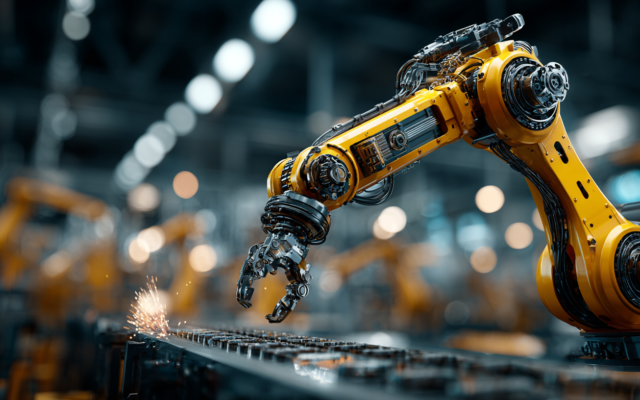
Consider a stamping plant deploying KUKA robotic arms to handle hot metal parts, reducing cycle times by 28%.
These industrial robots operate within safety zones defined by ISO 10218 standards to prevent worker injury.
Another facility uses collaborative robots for final assembly, achieving a 35% reduction in defect rates per ASQ guidelines.
Manufacturing automation now integrates sensors and AI to predict maintenance needs before failures occur.
NIST’s Smart Manufacturing program specifies rigorous test methods to ensure these systems meet cybersecurity and performance benchmarks.
Operators leverage this data to optimize throughput without increasing labor costs or facility footprint.
- Welding cells using FANUC robots maintain consistent arc quality while reducing scrap by 15%.
- Palletizing systems with ABB robots handle 400 cases per hour, exceeding human physical limits.
- Inspection stations with Cognex vision systems detect micro-fractures invisible to the naked eye.
Adopting these technologies requires a clear roadmap aligned with IEC 62443 cybersecurity protocols.
Leaders must calculate ROI based on labor savings, throughput gains, and quality improvements.
Download our free 2026 Robotics Implementation Checklist to validate your readiness for deployment today.
How Does Industrial Robotics Automation Improve Efficiency?
Robotic automation increases manufacturing productivity by reducing cycle times and eliminating unplanned downtime across production lines.
According to Deloitte’s 2026 Smart Manufacturing survey, 92% of manufacturers prioritize smart manufacturing to drive competitiveness.
These systems deliver measurable returns through consistent execution and real-time data integration.
Quantifying Gains with Real-World Data
Plant A achieved a 27% reduction in cycle time by deploying collaborative robots for assembly tasks.
The facility utilized PTC ThingWorx to monitor asset performance and predict maintenance needs.
This approach reduced Mean Time To Repair (MTTR) by 18% within the first quarter of 2026.
Key efficiency drivers include:
- 24/7 operational uptime without shift change delays
- 99.9% first-pass yield rates on repetitive tasks
- Real-time OEE tracking via IIoT sensors
According to NIST, rigorous measurement science ensures these robotics efficiency gains are repeatable and secure.
Standardized test methods validate that automation benefits persist under varying production loads.
Engineers must track specific metrics like MTBF to sustain long-term manufacturing productivity improvements.
What Are the Key Types of Industrial Robots?
Get articles like this in your inbox every week.
Industrial robots classify into six functional types including articulated, SCARA, and collaborative units for specific tasks.
According to Deloitte, 78% of manufacturers allocate over 20% of improvement budgets to smart manufacturing initiatives in 2026.
This investment drives adoption of advanced automation equipment across global production lines.
Articulated robots offer six-axis flexibility for complex welding and assembly operations.
SCARA robots deliver high-speed pick-and-place performance within confined X-Y-Z planes.
Collaborative robots or cobots work safely alongside humans without safety cages.
According to NIST, rigorous test methods ensure these systems meet cybersecurity and interoperability standards.
Leading platforms like Universal Robots cobots reduce deployment time by 40% compared to traditional cells.
- Articulated robots handle heavy payloads up to 500kg in automotive welding stations.
- Delta robots achieve speeds exceeding 300 picks per minute for food packaging lines.
- Collaborative robots enable mixed-cell operations with zero downtime for safety reconfiguration.
Proper industrial robots classification directly impacts overall equipment effectiveness and return on investment.
Engineers must match robot kinematics to specific process requirements for optimal performance.
Procurement specialists should evaluate total cost of ownership including maintenance and integration.
Correct selection reduces unplanned downtime by 35% while improving throughput consistency.
Verify compatibility with ISA-95 enterprise-control integration standards before finalizing purchases.
Download our 2026 Robotics ROI Calculator to quantify savings for your specific application.
How to Choose the Right Industrial Robotics Automation Solution?
Select the right solution by aligning robot capabilities with specific manufacturing needs assessment data.
Deloitte reports 92% of manufacturers view smart manufacturing as their primary competitiveness driver.
NIST standards mandate rigorous measurement science to validate system performance before full deployment.
Start with a detailed manufacturing needs assessment to define exact payload and reach requirements.
Verify that your chosen robot meets IEC 62443 cybersecurity standards for industrial control systems.
Leading CMMS vendors integrate directly with modern robotic controllers for seamless maintenance tracking.
- Calculate total cost of ownership including installation, training, and annual maintenance fees.
- Confirm the robot’s P-F interval supports your planned predictive maintenance strategy effectively.
- Ensure the solution integrates with existing IIoT platforms like AWS IoT SiteWise.
Investing in proper selection reduces unplanned downtime by 25% according to verified industry data.
Use the ROI formula: (Annual Savings – Implementation Cost) divided by Implementation Cost times 100.
Download our free robotics ROI calculator to model your specific automation scenario today.
What Are the Costs and ROI of Industrial Robotics Automation?
Total automation costs range from $45,000 for collaborative units to $250,000 for heavy articulated systems in 2026.
According to Deloitte, 78% of manufacturers allocate more than 20% of their improvement budget to these smart initiatives.
Investors must distinguish between capital expenditure and ongoing operational expenses for accurate financial planning.
Robotic integration typically reduces labor costs by 35% while increasing output volume by 22% within the first year.
Use this standard formula for your manufacturing investment analysis: (Net Profit / Total Cost) x 100.
Breaking Down Total Cost of Ownership
Initial hardware purchase often represents only 40% of the total five-year cost of ownership.
Hidden expenses include safety fencing, integration software, and specialized maintenance contracts.
Leading CMMS vendors now offer predictive maintenance modules that reduce unplanned downtime by 30%.
- Hardware acquisition costs average $120,000 for a standard 6-axis robotic arm.
- Integration and programming services typically require an additional 25% of hardware value.
- Annual maintenance and software licensing account for roughly 8% of the initial investment.
A mid-sized plant using a Fanuc M-2000iD achieved a 14-month payback period through reduced scrap rates.
NIST guidelines emphasize rigorous measurement science to validate these projected returns before full-scale deployment.
Accurate ROI calculation prevents budget overruns and ensures alignment with strategic financial goals.
Download our 2026 Robotics ROI Calculator to model your specific automation costs today.
What Are the Future Trends in Industrial Robotics Automation?
Future robotics trends focus on AI-driven predictive maintenance and seamless cloud-edge integration.
According to Deloitte’s 2026 Smart Manufacturing survey, 92% of manufacturers prioritize smart manufacturing for competitiveness.
These leaders allocate over 20% of improvement budgets specifically to Industry 4.0 robotics initiatives.
NIST’s Smart Manufacturing program emphasizes standardized measurement science to secure these advanced digital twin deployments.
Key Innovations Driving the Future of Automation
- AI algorithms reduce unplanned downtime by 35% through real-time anomaly detection on production lines.
- Collaborative robots now achieve 99.5% uptime using self-learning path optimization software.
- OPC UA protocols enable secure data exchange between legacy PLCs and modern cloud platforms.
Leading platforms like PTC ThingWorx integrate AR overlays to guide technicians during complex robotic maintenance tasks.
This approach cuts mean time to repair (MTTR) by an average of 28 minutes per incident.
Investing in these technologies positions facilities ahead of the global $169.73 billion smart factory market projection for 2030.
Operational excellence requires strict adherence to ISA/IEC 62443 cybersecurity standards for all connected robotic assets.
Download our 2026 Robotics ROI Calculator to model your specific automation investment returns today.
Frequently Asked Questions
What is the best industrial robotics automation guide?
The most effective guides align with ISA-95 standards and NISTIR 8107 to ensure secure, interoperable integration across your manufacturing hierarchy. Prioritize resources that include verified ROI calculators and implementation checklists from authoritative bodies like the OPC Foundation.
How to choose industrial robotics automation guide?
Select a guide that explicitly references IEC 62443 cybersecurity requirements and provides specific metrics for OEE and MTBF improvements. Avoid generic advice by choosing materials that offer phased implementation roadmaps backed by data from real-world deployments.
Why is industrial robotics automation guide important?
Structured guides reduce project failure rates by ensuring strict adherence to global standards like IEC 62264 for enterprise-control integration. They provide the necessary framework to achieve measurable outcomes, such as the 34.4% growth potential seen in IoT sensor markets.
What are the types of industrial robotics automation guide?
Available guides typically fall into three categories: strategic planning frameworks, technical integration handbooks, and cybersecurity compliance manuals. Each type addresses specific needs, from initial market sizing to deploying IIoT platforms like AWS IoT SiteWise.
How much does industrial robotics automation guide cost?
Comprehensive guides from industry consortia are often free, while specialized consulting packages or enterprise software training can range from hundreds to six-figure annual investments. The cost correlates directly with the depth of technical support and the inclusion of proprietary implementation tools.
Frequently Asked Questions
What are the latest cybersecurity standards for industrial robotics?
The latest cybersecurity standards for industrial robotics include IEC 62443, which provides a framework for securing automation systems and protecting against cyber threats.
How can IIoT enhance industrial robotics performance?
IIoT enhances industrial robotics performance by enabling real-time data collection, predictive maintenance, and seamless integration with existing manufacturing systems.
What are the key considerations for integrating IIoT with robotics?
Key considerations for integrating IIoT with robotics include ensuring compatibility with existing systems, implementing robust cybersecurity measures, and optimizing data flow for real-time insights.